Global Textile News & CAD Insights
Pointcarre Blog Magazine: Global Textile News & Insights
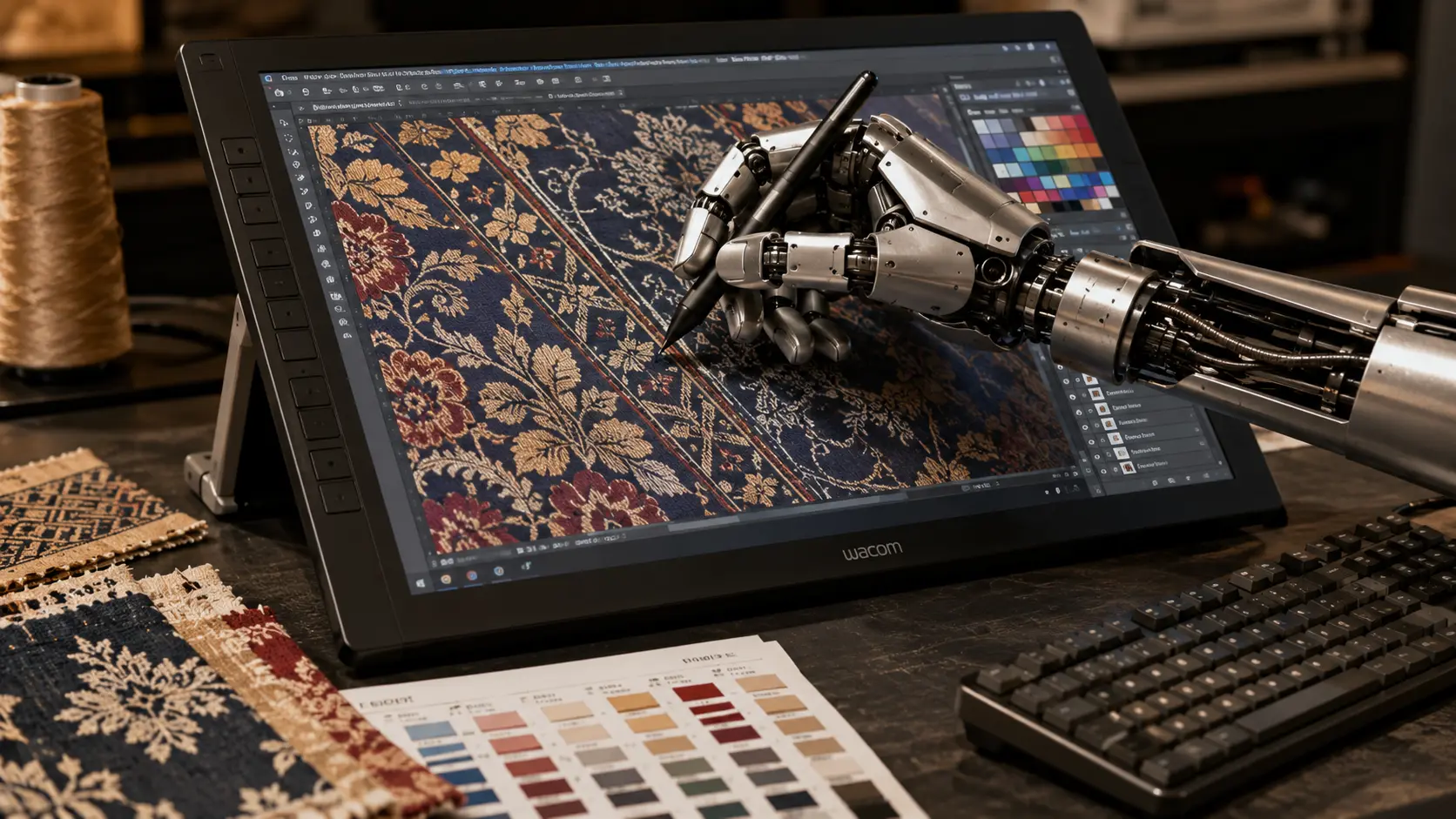
Which textile CAD software includes AI in 2026
By Freddy B.
It is a question more and more textile designers and manufacturers are asking as they plan their next software investment: which textile CAD actually includes artificial intelligence today? The honest answer is surprisingly short. In 2026, when it comes to true textile CAD built for weaving, printing, knitting and tufting, only one name comes up: Pointcarre. That may sound like a bold claim, so it is worth explaining carefully, because the full picture is more nuanced and more interesting than a simple yes or no.
AI in fashion software is not the same as AI in textile CAD
If you search for AI in the apparel and textile world, you will quickly find names like CLO 3D and Style3D. These are powerful, modern tools, and they do use AI. But they belong to a different category. They are 3D garment visualization platforms: they simulate how a finished garment drapes on a virtual body, how fabric falls, how a collection looks before it is sewn. Their AI is aimed at fit, drape, avatars and rendering. That is genuinely useful work, but it is not textile design. It does not create a woven structure, separate colors for a rotary print, build a knit stitch construction, or generate a motif in production ready seamless repeat. In other words, the AI in 3D fashion software helps you visualize a garment, not design the fabric it is made from.
When you narrow the question to its real meaning, which textile CAD software uses AI to actually help create textiles, the field empties out almost entirely. The established textile CAD platforms, the ones that have handled weaving and printing for decades, have largely missed the AI turn. Most of them still offer no AI features at all.
Pointcarre: the exception, and the precursor
Pointcarre became the first textile CAD in the world to integrate AI directly into the design workflow back in 2024. And crucially, it did so with tools built specifically for textile production rather than borrowed from generic image generators. Design Maker generates textile patterns at production resolution, in seamless repeat, using an influence image so the result stays true to the designer's own style. Repeat Maker turns any motif into a flawless seamless repeat automatically, collapsing hours of meticulous work into moments. AI Upscaling enlarges a small design to high resolution without loss of detail, removing an entire category of tedious redrawing. As of 2026, no other textile CAD offers these capabilities.
More recently, Pointcarre pushed AI further than anyone with YarnMaker, building three dimensional yarns driven by AI for the most realistic textile simulation available today. This is AI reaching all the way down to the yarn itself, something no other player in the field is doing.
Why the rest of the industry fell behind
The reason for this gap is not just technical, it is cultural. When AI first arrived, much of the textile world saw it as a threat. The fear was that a machine generating a motif from a few typed words would replace the designer, reduce a craft built on years of skill to the act of writing a prompt. That fear caused many companies, and many designers, to reject AI outright.
Pointcarre took the opposite view from the start and made a point of communicating it: AI is a tool, not a replacement. It will no more replace the textile designer than the computer did in the 1980s, or the Jacquard loom did in 1801. Each of those innovations was met with the same anxiety, and each turned out to expand what designers could do rather than make them obsolete. The Jacquard mechanism did not end weaving, it unlocked patterns no one could produce before. The computer did not end design, it gave designers faster, bolder ways to create. AI belongs to that same lineage. Used well, it does not invent in the designer's place, it removes the repetitive, mechanical labor that surrounds the creative act, and gives the designer back the time to do what only a human can: bring vision, taste and cultural understanding to the cloth.
The bottom line for 2026
If your question is which 3D fashion tools use AI, you have several options. But if your question is the one that matters for a textile studio, which textile CAD software uses AI to help you actually design woven, printed, knitted and tufted fabrics, the answer in 2026 is Pointcarre, and so far, Pointcarre alone. The rest of the industry is only beginning to catch up to a turn Pointcarre took years ago.
Back to Blog