Global Textile News & CAD Insights
Pointcarre Blog Magazine: Global Textile News & Insights
As easy as Weave Design
By Freddy B.
Look around the room you are sitting in. The chair, the curtains, the cushion, the cover of the book on the shelf, perhaps the case on your phone. Woven fabric, or the look of it, is everywhere. And here is the quiet truth of the design world: the need to create a convincing woven visual reaches far beyond the textile industry itself. A need that escaped the mill.
Weaving software was built for weavers
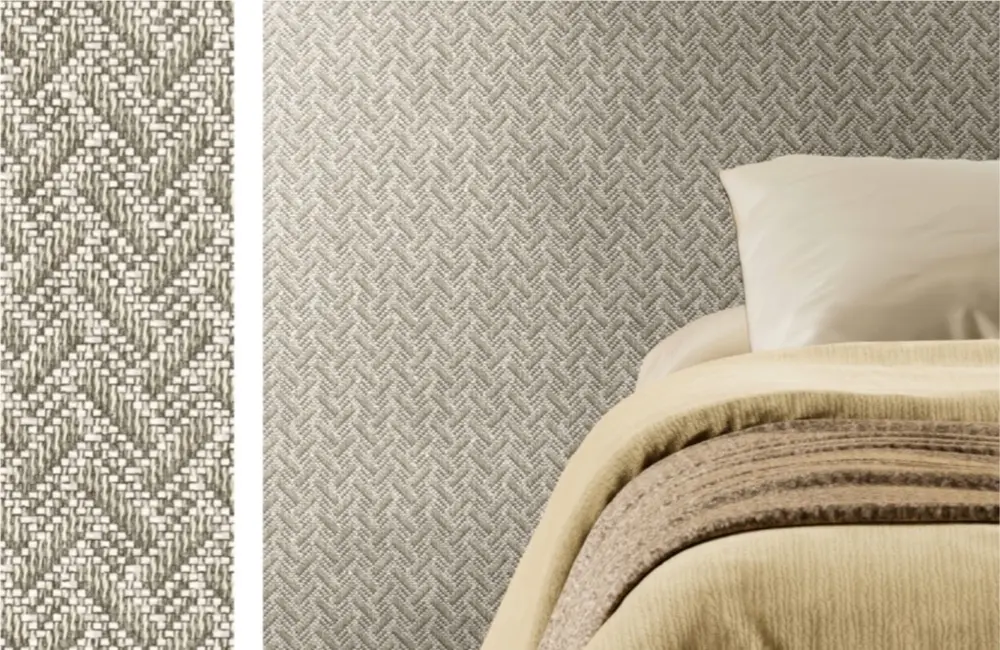
Weaving software was built, historically, for weavers. It assumed you understood warp and weft, threading and densities, the whole technical grammar of cloth. That made sense when the only people who needed a woven image were the mills producing the cloth. But that is no longer the case. Wallpaper manufacturers spend a large part of their work creating woven look visuals, because the texture of fabric sells a room. 3D graphic artists need realistic woven materials to dress their scenes. Bookbinders want to visualise fabric covers before committing to them. Designers prototyping a phone case, a packaging, a piece of furniture, all reach for the same thing: a believable woven surface. The demand for fabric imagery has spilled far outside the textile sector.
The problem is obvious once you see it. Not everyone who needs a woven visual has the skills to engineer a fabric and extract its image. Why should a photographer, an architect or a wallpaper designer have to learn the craft of a weaver just to produce a plaid or a stripe at the right density? That gap is exactly what Weave Design was created to close.
Built for the people around the craft, not only inside it
Weave Design is a deliberately approachable tool. It was not designed for the mill, it was designed for the design offices, the photographers, the architects, the creators who need the result without the technical burden. It lets anyone create checks, stripes and Jacquard style fabrics without technical requirements.
The logic is simple. Color sits at the heart of the software, and the colors you use are guaranteed to stay the same throughout the whole process. You define colorways for the warp and the weft, draw the yarn layout directly on the cloth or enter it as a simple formula, and quickly build plaids and stripes at the right density. The software comes with a yarn library, 4,000 structures and the Pantone Textile Library, so you can reference real yarn colors and drop them straight into your design. Then it is easy to create quick, accurate woven simulations with any kind of yarn, bouclé, chenille, slub, twisted, with irregular densities taken into account for a realistic result.
In other words, the technical heavy lifting happens underneath, out of sight, while you stay focused on the look you want.
Simulation so real it replaces the sample, powered by YarnMaker
What makes the result truly convincing is the simulation. Weave Design benefits from YarnMaker, Pointcarre's 3D yarn technology, which builds genuine three dimensional yarns, defining filaments, twist and fiber nature, and reproducing how each one behaves and reflects light. The outcome is a woven visual of extraordinary realism, the kind of image you can place in a catalogue, a 3D render or a product mockup and trust completely. The quality of the Pointcarre simulation is recognised by prominent textile designers, and it lets you validate on screen rather than on a costly physical sample.
The whole philosophy in one idea
This is, in the end, what the Pointcarre team has always believed: the software should make your work easier, not harder. You do not need to be a weaver to create a beautiful, accurate woven fabric. You do not need years of technical training to extract a perfect fabric visual. Whether you come from a style office, a photography studio, an architecture practice or a wallpaper house, the expertise is built into the tool. You bring the idea. Pointcarre handles the cloth. It really is as easy as Weave Design.
Back to Blog