Global Textile News & CAD Insights
Pointcarre Blog Magazine: Global Textile News & Insights
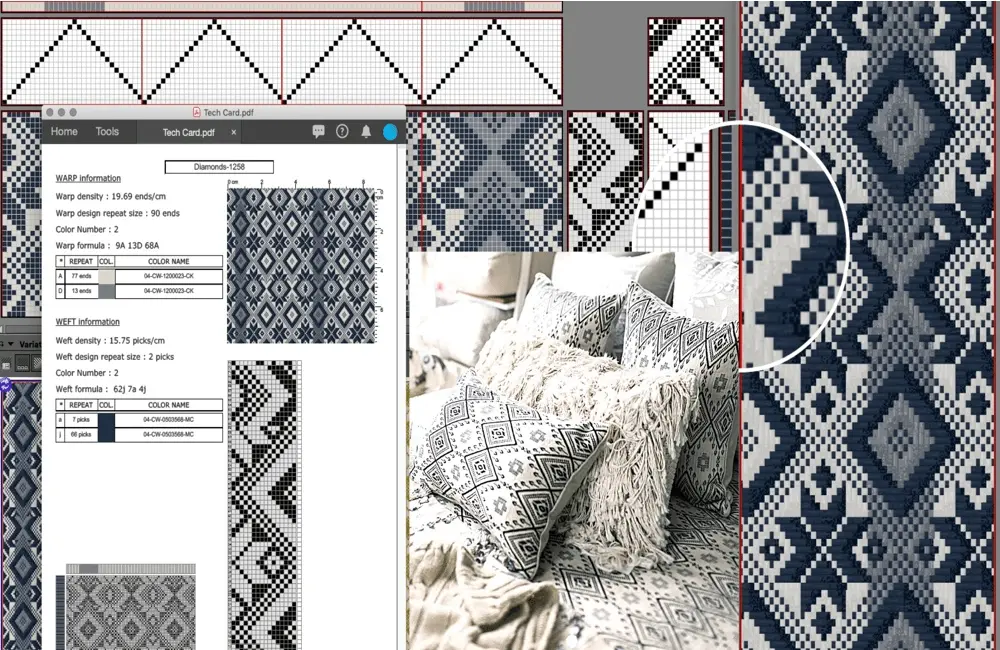
The Dobby Revolution: How Pointcarre Turns Weave Design Into an Agile, Visual and Intelligent Hub
By Freddy B.
For decades, dobby weave design software followed a single, unspoken rule: power had to come at the price of complexity. The most established tools in the industry built their reputation on technical depth, but that depth came wrapped in austere interfaces, steep learning curves and rigid workflows. Designers were expected to think like textile engineers before they could think like creators. In 2026, that trade-off no longer holds. Pointcarré is rewriting it.
The old model: power buried under complexity
The historic platforms that shaped digital weaving were undeniably capable. They could handle the most demanding constructions, and many mills still rely on them. But capability is not the same as agility. Across the industry, the same frustrations keep surfacing: interfaces that have aged poorly, menus stacked upon menus, and onboarding that can take months before a new designer becomes productive. Worst of all, most of these systems missed the two turning points that now define modern design work: intelligent automation and built-in AI.
The result is a workflow that still leans heavily on trial and error, and on the costly ritual of physical sampling. In a market that demands speed, flexibility and constant variation, that rigidity has quietly become a liability.
What the new generation of weavers actually wants
The designers entering the industry today have different expectations, shaped by the tools they use everywhere else in their lives. They want the end of the technical barrier. Threading, treadling, peg plans, all the underlying mechanics should become transparent and fluid, not a wall to climb. The technique should serve the creativity, not the other way around.
They want an immediate digital twin. The ability to modify a dobby weave, swap a weft yarn or an effect thread, and see the relief, the weight and the sheen recalculated on screen in a fraction of a second. No waiting, no guesswork.
And they want intelligence and automation built in, so they stop losing hours on repetitive tasks and on translating files for the loom.
The Pointcarré answer: creation and rigor, reconciled
This is exactly the gap Pointcarré Dobby Weave was built to close. Where the old guard pile on complexity, Pointcarré merges pure creativity and technical rigor inside one intuitive interface. A designer draws the warp layout directly on the cloth, builds plaids and stripes that respect the real densities, and pulls from a library of 4,000 weaves, enriched with their own structures, simply by dragging and dropping.
The simulation engine is where the shift becomes undeniable. Pointcarré produces a true digital twin of the fabric, accurate with any kind of yarn, including bouclé, chenille, slub and twisted, and faithful even to irregular densities. Designs are no longer validated on an expensive physical sample, they are validated on screen. The quality of this simulation is recognized by major textile manufacturers and converters, and it cuts sampling costs directly.
Pointcarré is also the strong link in the Industry 4.0 chain. By intelligently automating the technical data, it issues a complete, customizable spec sheet and drives the loom directly, whether Stäubli, Dornier, Somet, Sulzer or Picanol. The weaver no longer adapts to the software, the software propels the production in a single click.
When AI reaches the yarn itself: YarnMaker
The most forward-looking part of this story is what happens when artificial intelligence moves all the way down to the yarn. As the first textile CAD in the world to embed AI, Pointcarré has applied it not as a gimmick but as a way to erase repetitive work. And with YarnMaker, the company now builds three-dimensional yarns driven by AI, defining filaments, twist and fiber nature, then reproducing how the yarn behaves and reflects light in the woven cloth.
For dobby design, this is transformative. The yarn is no longer a fixed input chosen from a catalogue, it becomes a designable, simulatable object. A designer can construct a yarn, drop it into a weave and instantly see the realistic result, while spinners can imagine entire yarn ranges without going through the long physical prototyping process. Beyond the time saved, the environmental gain is real: every sample evaluated on screen instead of on a machine spares material, energy and water.
Conclusion: the future of dobby is already here
The platforms that pioneered digital weaving wrote its history. Pointcarré is drawing its future. The new generation of dobby designers no longer has time for unnecessary complexity. By radically simplifying the workflow, combining an intuitive interface, an ultra-faithful digital twin, direct loom control and AI that reaches all the way into the yarn, Pointcarré does not just offer one more alternative. It defines what modern weave design should be.
Back to Blog