Global Textile News & CAD Insights
Pointcarre Blog Magazine: Global Textile News & Insights
The story of Pointcarre
By Olivier M.
In the early 1980s, when most of the textile industry still relied on centuries old methods, a self taught weaver in Brittany was quietly revolutionizing fabric design using nothing more than a passion for weaving, a stolen computer programmer's mindset, and a very specific unit of measurement called the point carré. That weaver was Olivier Masson, and the software he created would eventually become Pointcarre, one of the world's most influential textile CAD tools. But the path from hand drawn patterns on grid paper to a fully functional graphics based software wasn't straightforward.
The square point
The story begins not in Silicon Valley, but in Morocco, in 1976. Masson, then a young weaver on a government cooperation project, approached a local carpet factory with an unconventional idea: custom rugs featuring his own stylized animal designs. He translated his grid paper drawings into specifications the craftspeople could understand, using a simple unit of measurement: one square on his paper would equal one 1cm square on the finished carpet, a scale that suited the traditional knotting density of 36 knots per centimeter.
One point carré, as he called it, would become the philosophical and literal foundation of everything that followed. It was elegant simplicity applied to complex design. But it was also, as the carpet factory's weavers would discover, too abstract for traditional methods. The project never materialized, but the concept would not die.
The unexpected pivot
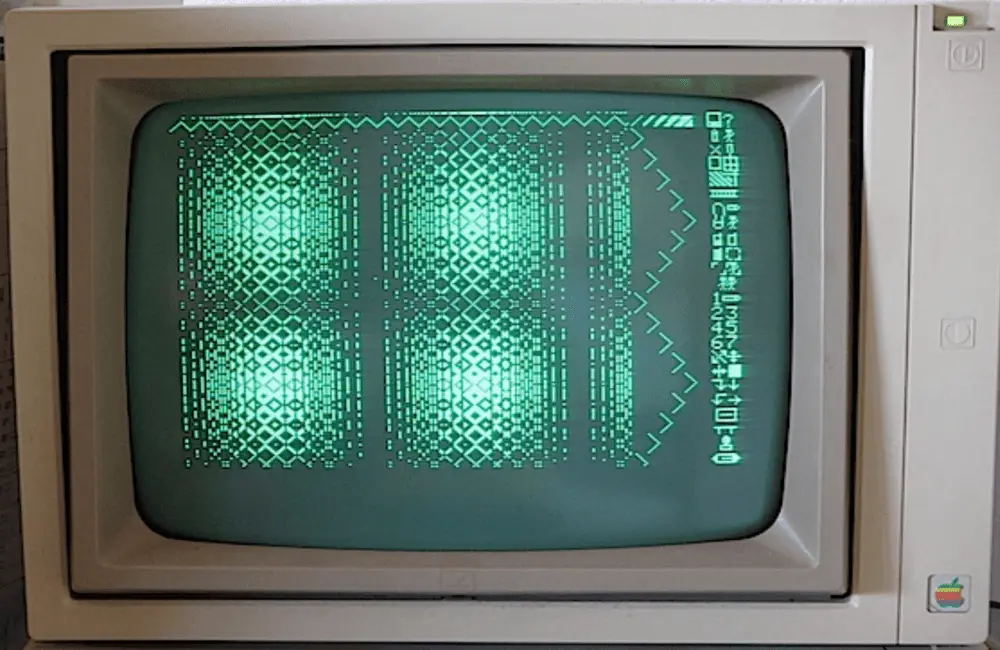
When Masson returned to Brittany in 1981 and joined the regional weavers' syndicate, he encountered something unexpected: a polytechnic engineer named Henri Lazennec had recently introduced computers to the guild. Henry had even written software called Création et tissage to help weavers design on Apple II machines. Masson, whose father had been a pioneering computer scientist, had sworn off programming as a teenager. He'd watched his father work late into every evening and wanted no part of it. But standing in front of those Apple IIs, something clicked. When I saw the obvious connection between my passion for weaving and computing, Jacquard looms with punch cards were the ancestors of computers, I cracked, he would later recall.
In August 1982, he enrolled in Lazennec's Basic programming course. A week later, he bought the cheapest computer on the market: a ZX81. What followed was a descent into obsessive learning, first in Basic, then in assembly language, motivated by the revelation that machine code could make his drawing program run 100 times faster. I had appended the key and realized the image was already on screen, he remembered of that moment. I felt a surge of power.
Invention under pressure
By 1984, Masson had migrated to an Apple II and was working on two separate programs, one for drawing, one for weaving calculations. Then came the eureka moment: what if he could draw directly on the warp and weft diagram with a mouse? I threw myself feverishly into writing a single, unified program, he said. For ten days, barely leaving his office except to sleep and eat, he merged the functionalities of his drawing tool with the technical rigor of weaving design. The result was the first entirely graphics based weaving software controlled by a mouse, what would become Pointcarre.
The name came full circle. From the grid paper squares in Morocco to the pixels on screen, the point carré had evolved from a unit of measurement into the foundational concept of a software system that made textile design intuitive, accessible, and fast.
The evangelist
When Olivier first showed the software to his friend François Roussel, a fellow weaver, Roussel immediately grasped its potential. Where Olivier was a developer, Roussel became an evangelist, traveling textile studios and design offices across France, Europe, and eventually Canada with demos of this strange new tool. You might make more money selling the software than selling your textiles, Roussel told him one day. The idea took root. On December 1, 1987, they formalized what had been a passion project into a business: Pointcarré SARL was born.
Legacy
Forty years later, Pointcarre remains the only native textile CAD running seamlessly on both Mac and Windows in a single application. It's taught at NC State and every textile design school in India. Its AI features, Design Maker, Repeat Maker, and YarnMaker, are reshaping how the industry thinks about automation. But perhaps the most remarkable aspect of Pointcarre's origin story is what it reveals about innovation itself: it wasn't born from venture capital, market research, or five year plans. It was born from a weaver who refused to accept the limitations of existing tools, who taught himself an entirely new language, and who believed that technology should serve creativity, not the reverse.
The point carré, that simple unit from Moroccan carpets, remains the conceptual heart of Pointcarre today. A reminder that sometimes the best innovations come not from disrupting industries, but from honoring craft while embracing what's possible. Pointcarré celebrates over 40 years of innovation in textile design software. The story of Olivier Masson and the origins of Pointcarre is told in fuller detail in his personal account, available on his website.
Back to Blog