Global Textile News & CAD Insights
Pointcarre Blog Magazine: Global Textile News & Insights
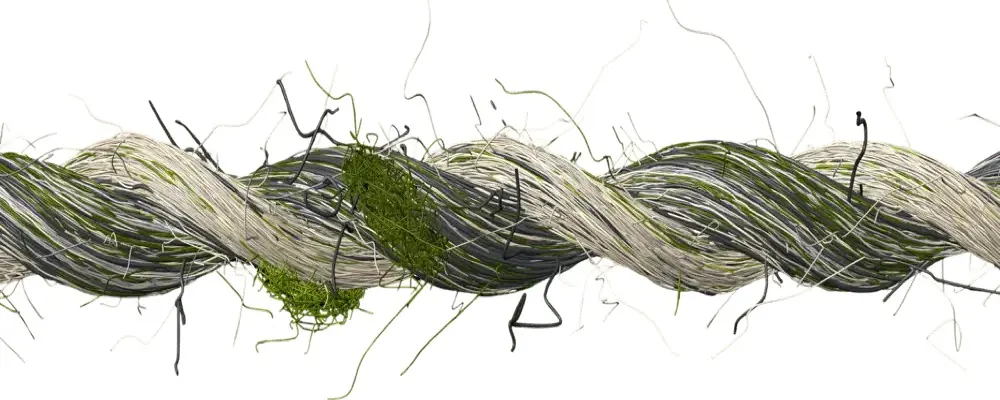
When Textile CAD Starts Designing Yarn: The Rise of 3D Yarn Simulation
By Freddy B.
For decades, textile design software focused on the fabric itself. The weave, the print, the knit, the colour were the tools in the designer's hands. The yarn itself, the very building block of every textile, was treated as a given, a starting material chosen from a supplier's catalogue. That is now beginning to change. As computers become powerful enough to calculate vast amounts of information almost instantly, textile CAD software is starting to design and simulate yarn itself, in three dimensions.
This shift is worth examining closely, because it touches not only designers but also spinners, manufacturers, and the environmental footprint of the entire industry.
From fabric design to yarn design
One company illustrating this trend is Pointcarré, which has been developing textile CAD software for both Mac and PC for over 40 years. In 2024 it became the first textile CAD to introduce AI for generating motifs from a text prompt. In 2025 it added automatic repeat and instant resolution upscaling, allowing a small motif to be enlarged in moments rather than hours of manual rework.
This year, the company unveiled something different at Techtextil in Frankfurt: a yarn creation tool called YarnMaker. The announcement did not go unnoticed, because the implications reach well beyond a single software feature.
Building a yarn on screen
The principle is straightforward in concept and remarkable in practice. By reproducing a yarn in three dimensions, the software can replicate how that yarn behaves during weaving, and simulate its true appearance, because the yarn carries the correct colour reflectance. In a few clicks, a user builds the yarn by choosing the number of filaments, the twist, the fibre nature, whether cotton, linen, silk or another material.
For designers, the value is immediate. They can preview a fabric with genuine accuracy before a single thread is produced, seeing not just a flat colour but the real texture and behaviour of the chosen yarn within the weave. This removes guesswork and reduces the need for expensive physical samples.
A new tool for spinners
The benefit extends far beyond designers to the spinners themselves. Traditionally, designing a new range of yarn means producing a physical prototype and then running it through a lengthy sequence of tests, where the yarn is scanned, twisted, stressed and broken to assess its properties. With 3D yarn simulation, spinners can begin to conceive and evaluate an entire range of yarns digitally, without immediately committing to full physical production. This compresses development time and lowers the cost of experimentation significantly.
An environmental dimension
Perhaps the most important benefit is environmental, and it deserves as much attention as the technical advantages. Not having to physically produce a yarn or a woven sample is not only a matter of saving time. The manufacturing process is energy intensive and polluting, and so is the sampling process at a weaving mill. Every prototype that can be evaluated on screen instead of on a machine represents material, energy and water that are not consumed. As the industry faces growing pressure to reduce its footprint, digital simulation of yarn and fabric becomes a genuine sustainability tool, not just a convenience feature.
What comes next
The logical next step, already on the horizon, is to add artificial intelligence to the yarn creation itself, so that a simulated yarn can send pricing information directly back to its designer. This is technically feasible, and it points toward a future where the line between design and costing begins to blur. A designer could, in principle, build a yarn, see how it looks and behaves in a fabric, and know its price, all before committing to physical production.
The broader lesson is that computing power is pushing textile CAD into territory it never occupied before. Yarn, long treated as a fixed input, is becoming a designable and simulatable object. For designers it means better previews, for spinners faster development, and for the planet less waste. It is a quiet but meaningful turning point for an industry that has always balanced craft with technology.
Back to Blog